
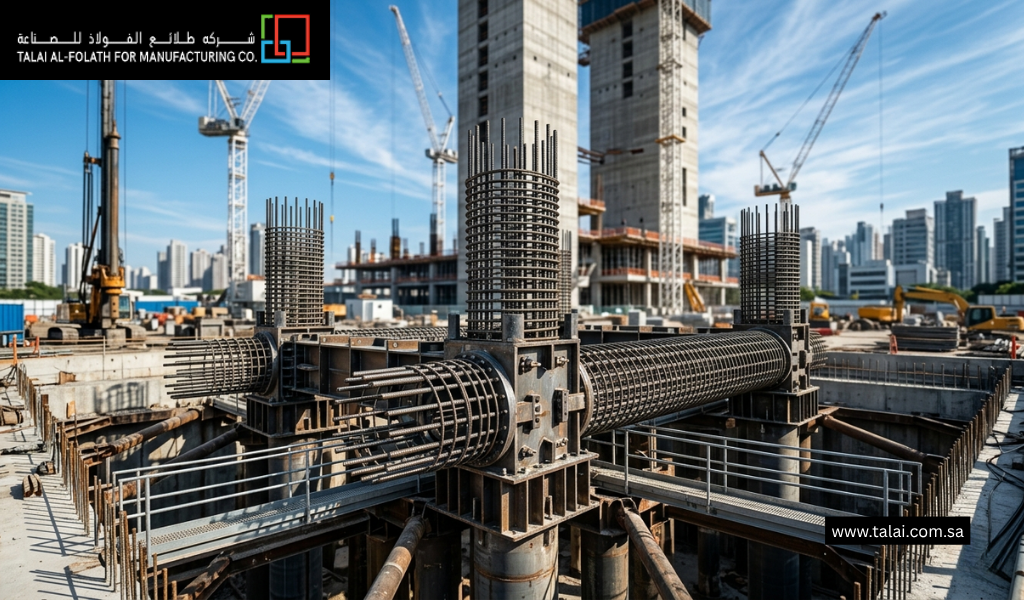
As such, both high-rise buildings and industrial developments require strong and reliable foundations in modern construction projects. This is where piles assembly comes to one of the fundamental moments in construction. Be it a commercial Tower, manufacturing unit, warehouse or residential skyscraper – the complete structure’s stability is dictated by the foundation system.
Carefully detailed piles pileup process maximizes load-bearing capacity and reduces structural risk, resulting in long-lasting safety. In this day and age, developers and contractors use pile construction methods that are designed to create sturdy-weight bearing foundations that can bear the environmental pressure below ground as well as mega structural loads above.
What is Piles Assembly in Construction?
In construction, piles assembly refers to arranging, installing and connecting piles for a stable foundation support system. Piles are deep foundation elements that are used to transfer the loads coming from the building down to more suitable soil or rock layers found below the ground surface.
That method is widely implemented when the upper soil stratum is weak and cannot bear up the load of the structure. A good, stable pile foundation keeps the house upright and avoids settlement, cracks, and eventual structural failure.
In modern infrastructure projects, piles assembly is widely used for:
- High-rise buildings
- Industrial plants
- Bridges and flyovers
- Warehouses
- Commercial complexes
- Marine structures
Proper piles assembly ensures that the structure remains stable even under heavy loads and harsh environmental conditions.
Why Piles Assembly is Important in High-Rise Projects?
High-rise buildings exert enormous pressure on the ground. Standard shallow foundations are often not sufficient to support these structures. This is why piles assembly plays a critical role in modern urban construction.
1. Improves Structural Stability
Deep pile foundations distribute the building load evenly into stronger soil layers. This reduces the risk of uneven settlement and structural movement.
2. Supports Heavy Loads
Tall buildings require foundations capable of carrying massive vertical and lateral loads. Advanced piling construction methods provide the strength needed for these demanding projects.
3. Enhances Safety
A professionally designed building foundation piling system minimises the chances of foundation failure, making the building safer for occupants and long-term use.
4. Suitable for Challenging Soil Conditions
In many urban areas, soil conditions are weak or inconsistent. Piles assembly allows construction even on difficult terrains by transferring the load to deeper stable layers.
How does Piles Assembly Work in High-Rise Buildings?
The piles assembly process in high-rise buildings involves several carefully planned steps. Every stage must be executed with precision to ensure the foundation performs efficiently for decades.
Site Investigation
Engineers first analyse the soil condition through geotechnical surveys. This helps determine the suitable pile type and depth.
Foundation Design
Based on the soil report and building load, experts design the building foundation piling system that best suits the project.
Pile Installation
Specialist pile installation contractors use heavy machinery to install piles deep into the ground using different piling construction methods.
Pile Cap Construction
Once the piles are installed, pile caps are constructed to connect multiple piles and distribute structural loads evenly.
Quality Testing
Load testing and integrity testing are performed to ensure the piles meet engineering and safety standards.
This systematic process ensures long-lasting structural performance for high-rise and industrial projects.
What are the Different Types of Piles Assembly?
Different construction projects require different pile systems depending on soil conditions and structural requirements.
Driven Piles
These piles are driven into the ground using hydraulic hammers or vibratory equipment. They are commonly used in large industrial projects.
Bored Piles
Bored piles are constructed by drilling holes into the ground and filling them with reinforced concrete. They are ideal for urban high-rise construction.
Screw Piles
These piles are rotated into the ground like screws. They are suitable for lightweight structures and projects requiring fast installation.
Sheet Piles
Sheet piles are mainly used for retaining walls, waterfront structures, and excavation support systems.
Composite Piles
Composite piles combine materials such as steel and concrete to improve durability and load-bearing performance.
Experienced pile installation contractors select the right pile type according to the project specifications and soil conditions.
The Role of Pile Installation Contractors
Choosing skilled pile installation contractors is essential for project success. Professional contractors bring technical expertise, advanced equipment, and quality assurance to the construction process.
Reliable contractors help with:
- Accurate soil analysis
- Efficient piling construction methods
- Timely project completion
- Compliance with safety regulations
- Reduced construction risks
- Long-term structural durability
A trusted contractor also ensures the piles assembly process meets engineering standards and project deadlines.
Conclusion
Piles assembly is the cornerstone of safe and long-lasting high-rise and industrial structures nowadays in the construction industry. Whether for increasing the structural strength of construction or accommodating heavy loads, a correctly designed system for building foundation piling provides durability and reliability to endure through ages.
Employing the new piling construction technologies and engaging best pile installation service providers help developers mitigate their risk, enhance method of building and ensure best project completion. Acquiring professional piles assembly answers does much more than include an excellent heart only-it makes a stronger, even safer construction on the long term.
FAQ’s Related to Piles Assembly
1. What is the purpose of piles assembly?
Piles assembly helps transfer the structural load of a building to deeper and stronger soil layers, ensuring stability and safety.
2. Which piling construction methods are commonly used?
Common methods include bored piling, driven piling, screw piling, and continuous flight auger piling.
3. Why is a building foundation piling system important?
A building foundation piling system prevents settlement, supports heavy loads, and improves the lifespan of the structure.
4. How do pile installation contractors ensure quality?
Professional pile installation contractors conduct soil testing, use advanced equipment, and follow engineering standards throughout the installation process.
5. Where is piles assembly commonly used?
Piles assembly is widely used in high-rise buildings, industrial plants, bridges, warehouses, and large infrastructure projects.